

From Fuji to Frostbite: JDM Cars Built for Canadian Winter (Part 2)
Updated: Jul 22
Not all JDM cars melt when the snow hits. Hidden among Japan’s family vans and highway cruisers are true winter beasts—machines that can chew through slush, ice, and your unplowed street without complaint. These are the imports that actually belong in Canada’s winter.

So you’ve decided to daily a JDM import in Canada. Bold move. Somewhere between “I value reliability” and “let’s see what happens,” you’ve chosen to unleash a right-hand-drive Japanese masterpiece into a land where winter lasts longer than most relationships. You’re about to pit precision Japanese engineering—designed for Tokyo commutes and maybe a light Hokkaido flurry—against Canadian roads that look like a frozen moonscape salted by someone with a personal vendetta. And while some JDM cars, like the Nissan r32 Skyline, have no business anywhere near a snowbank,...
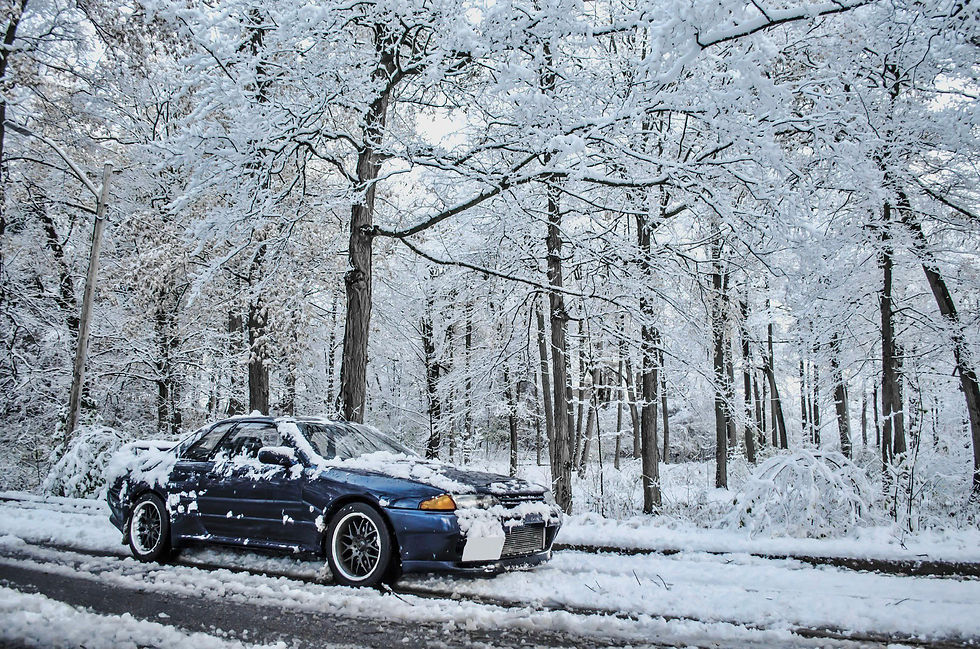
....there are some cars that brush off cold weather like dandruff from your shoulder. Some have a lengthy rally lineage; others just have 4WD editions and a great deal of common sense.
Surprisingly, Japan actually built a number of machines that thrive in the cold—vehicles that churn through snowdrifts, ignore -30°C mornings, and laugh at the cruel, cruel things Ontario does to undercarriages. You just need to know which ones won’t leave you stranded, crying into your Tim Horton's cup as your battery taps out like an MMA fighter in round one.
This guide—Part 2 in our “Winterizing your JDM ride” series—is where we break down which Japanese imports actually deserve a place in your snow-filled, frostbitten future.
JDM rides - winter Buyer's Guide
So all of this leads to the big question: “Are there any great JDM vehicles out there built for Canadian winters?”
Yes — absolutely!
Before we fire off a shopping list of turbocharged snow slayers, let’s talk about the criteria. Because not every JDM car is built for winter. Some were built for family trips to Aeon Mall. Some for running sushi deliveries. And some… well, some were built to dominate rally stages and won’t even notice the snow unless it’s up to the headlights.
Here’s what makes our shortlist:
1. Real AWD or 4WD
We’re not interested in “AWD” systems that were basically marketing exercises. We want the real, mechanical, torque-sending, snow-eating stuff:
Subaru’s full-time symmetrical AWD
Mitsubishi’s Super Select 4WD and AWC
Toyota’s proper 4WD systems (Harrier, Hilux Surf, Alphard/Vellfire AWD)
Honda’s legit RealTime 4WD (CR-V, Odyssey RB4)
If the system can’t claw its way up your unplowed cottage road at 6 a.m., it’s not going on this list.
2. Under 100,000 km (Preferably)
Because Canadian winters don’t care about your feelings or your maintenance schedule. If a car is already pushing 200,000 km, adding salt, potholes, ice heave, and your questionable decision-making will finish it off quicker than you can say “unexpected repair bill.”
We aim for:
80–120k km sweet spot
Auction grade 3.5–4.0 (or higher if you can find it)
Minimal rust because rust repair is “mortgage conversation” money
3. Parts Availability in Canada
This is a big one. Some JDM cars share:
Engines
Drivetrain parts
Suspension
Filters
Brakes
…with Canadian or USDM equivalents.
Others are… Toyota Vellfires.
So while all of our picks can survive winter, some will be easier to maintain than others. We’ll flag which are “Canadian-friendly” (Subaru WRX, CR-V) and which require occasional parts-hunting safaris (Pajero, Delica, Alphard).
4. Proven Winter Pedigree (or Rally DNA)
Some cars on this list don’t just survive winter—they live for it.
Looking at you:
Subaru WRX/STI
Mitsubishi Lancer Evolution (VIII–X)
Pajero (Dakar royalty)
Delica (Japan’s unofficial snow-country shuttle)
Hilux Surf (because your driveway is now an expedition)
If a car has spent decades winning events that involve mud, snow, ice, and questionable terrain, it’s basically pre-qualified for Canadian roads.
5. Value for Money (Because Importing Isn’t Free)
We’re recommending cars that:
Provide the most capability per Canadian dollar
Are realistically findable at Japanese auctions
Aren’t completely ruined by drifting teenagers
Won’t bankrupt you during shipping and compliance
Yes, the Evo X is amazing in the snow. No, you don’t need to spend $35k FOB Japan to daily one in Sudbury just to flex.
With that said, here are some of our top picks for model years 2005-2011 (keeping in mind the 15 year import rule means 2011 becomes eligible in 2026).
6. Price at dealership
For sake of ease, we're looking at Be Forward and Goo Net for prices. That is dealership price. Our dollar values below are Price at dealer in Japan - before import costs.
Auction prices can be way cheaper (potential even lower than 50% of the dealership price). Wanna see how low? Make a free account with our friends at Japan-Motor!
Wanna find the price after import costs? Subscribe for free and link to our member's-only import calculator!
Subaru
Subaru Impreza WRX / Subaru Impreza WRX STI (2000-2011)
A rally-bred AWD performance car designed for fun and snow alike: Subaru’s full-time Symmetrical AWD plus driver-tunable centre diff on the STI make it a winter-capable thrill machine. Its motorsport legacy and JDM pedigree (WRC roots) deliver character you won’t find in many other imports; Colin McCrae and Tommi Makinen swear by them!
Maintenance & Parts Reality: Subaru Canada and local Subaru dealers will handle routine service (fluids, brakes, filters) quite easily. JDM-specific trims or RHD electronics may require you to bring OEM part numbers. Many body panels and mechanical components share with Canadian WRX/WRX STI (2008–2011) models, so panel/part interchange is good.URL Reference: https://www.reddit.com/r/WRX/comments/1iow3io/anybody_else_does_their_own_maintenance
Typical km for nice imports: ~60,000–110,000 km
Ballpark price (grade ~4, <100k km):
Early GD (2000–2005): ~¥1.0–1.6M → ~CA$9,000–14,000
Late GD / GRB hatch (2006–2011): ~¥1.5–3.0M → ~CA$13,500–27,000
Typical auction grade: 3.5–4.0 for 80–130k km cars, 4–4.5 for the cleaner low-km ones.
Subaru Forester (2008-2011)
Practical compact SUV with Subaru’s symmetrical AWD, good ground clearance and winter readiness built-in—the type of JDM import that’s daily-friendly and snow-capable.
Maintenance & Parts Reality: Very good interchange with Canadian Forester models (shared platforms/parts). Service is straightforward at Subaru dealers. For JDM RHD or trim differences, you may need to source unique interior bits.
At Auction
Typical km: ~80,000–130,000 km for exportable SH-series Foresters.
Ballpark price (grade ~4, <120k km): ~¥700k–1.3M → CA$6,000–12,000 (turbo & special trims at the top).
Typical auction grade: 3.5–4.0 (utility cars, often family-used, but Subaru mechanicals usually solid).
Mitsubishi
Mitsubishi Lancer Evolution IIX through X (1996-2011)
You saw it in Tokyo Drift and 2 Fast 2 furious. It doesn't do drifting unless it's a snow drift (my one dad joke for the day - I promise). A hardcore driver’s JDM sedan with advanced AWD systems (ACD, AYC) derived from rallying—excellent in snow when set up properly. The Evo X was officially sold in North America (so service/parts are easier); the Evo IX (JDM only) is more “import-specialist”. You can go back further in to the 90's and see the true rally pedigree of the Evo's with their big-ass rally headlights!
Maintenance & Parts Reality: For the Evo X, most mechanical, AWD-system and drivetrain parts are shared with North American spec—dealers and performance shops are generally familiar. For Evo IX or earlier, expect more importing of certain JDM-only parts and less panel/part interchange with Canadian Lancers (since Canadian markets didn’t receive Evo IX).URL Reference: https://www.carthrottle.com/news/idiots-guide-mitsubishi-lancer-evolution-history-generations-and-our-rankings
Evo VIII (roughly 2003–2005)
Typical km: ~90,000–140,000 km (low-km hero cars exist but cost big money).
Ballpark price (grade 3.5–4, <140k km): ~¥1.4–2.2M → CA$12,500–20,000.
Typical grade: 3.5–4.0 (age + mods usually drag grade down a bit).
Evo IX (roughly 2005 - 2007)
Typical km: ~80,000–130,000 km.
Ballpark price: ~¥1.8–2.8M → CA$16,000–25,000.
Typical grade: 3.5–4.0, with unicorn grade-4.5 cars at higher price.
Evo X (2007 - 2016, CZ4A)
Typical km (nice examples): ~30,000–80,000 km on dealer stock.
Ballpark price: ~¥3.0–3.8M → CA$27,000–34,000 for clean GSR X 4WD, ~30k–60k km.
Typical grade: 4–4.5 on low-km, unmolested cars; 3.5–4 if modded or higher mileage.
Mitsubishi Delica L400 (2008-2011)
Possibly the coolest off-road van out there, the Delica is a uniquely Japanese MPV/van with selectable 4WD (2WD/Auto/Lock) and higher clearance—makes it a sleeper winter choice for families or gear-haulers who want winter traction with space. While the Delica Space gear model is still considered one of the very best iterations, both subsequent and earlier models still come off quiet well.
Maintenance & Parts Reality: Poor to no interchange with Canadian Mitsubishi models as there’s no equivalent Delica in Canada. So, parts will often need import or specialist sourcing. Routine service is okay, but body panels and 4WD system parts may be harder to source locally. URL Reference: https://blog.beforward.jp/car-review/mitsubishi-delica-d5.html
Delica Space Gear (L400) – years & prices
Production: mid-1990s to around 2007; there is effectively no 2008–2011 new production, only older stock still on the market.Goo-net Exchange+1
Typical km (2002–2006 examples): ~90,000–150,000 km.
Typical price:
Roughly ¥800k–1.4M for nicer Chamonix / Super Exceed 4WD vans
→ about CA$7,000–12,500.Goo-net Exchange+1
Typical grade: 3–3.5 (older 4x4 van; age & rust risk bump grades down).
Delica D:5 (CV5W, 4WD, 2008–2011)
Typical km: ~80,000–120,000 km.
Ballpark price (grade 3.5–4, 4WD): ~¥1.0–1.5M → CA$9,000–14,000.
Typical grade: 3.5–4 (family hauler with some battle scars).
Mitsubishi Pajero (2008-2011)
Let’s start small and work our way up—because like Timbit boxes, Pajeros come in two sizes: Short and Long.
Short Wheelbase (3-Door) Variants – Compact Winter Brawler
This version was Mitsubishi's answer to the Suzuki Samurai. A small 2 person off road ride with the fiction to believe that the back seats could be used for humans. That said, its performances in the Paris-Dakkar rally are the stuff of legend.
VR-I (V83W)The base shorty—two doors, 5 seats, and a 3.0 L V6 (6G72). Think of it as the “fun-size” Pajero: easier to park, great for cottage trails, and ready to plow through snowbanks like a caffeinated snowblower.Canadian Comparison: Closest spiritual cousin to the older Montero RS or early 2000s Pajero SWB, though none were officially sold here after 2006. Mechanical bits (fluids, filters, suspension components) are largely compatible with global-spec Pajeros.
VR-II / VR-S (rare short trims) Slightly better interior trim and wheel upgrades; still the same short wheelbase and drivetrain. Occasionally badged as “VS” or “Super Short” in dealer listings.Canadian Comparison: No direct local equivalent—imagine a Montero Sport that hit the gym.
Pajero Short (3-door, ~V83W)
Typical km: ~80,000–130,000 km.
Ballpark price (grade 3.5–4): ~¥900k–1.5M → CA$8,000–13,500.
Typical grade: 3.5–4.0 (shorties often see more off-road use).
Long Wheelbase (5-Door) Variants – The Family Snow Tank
Closest in size and configuration to the Montero Limited sold here up to 2006, this version of the Pajero is the big daddy of the family.
GR (V93W)Mid-level long-body Pajero, 3.0 L petrol or 3.2 L diesel, depending on spec. “GR” roughly translates to good but not fancy. You get the rugged 4WD system (Super-Select II) and a durable interior that can take muddy boots without complaint. Many mechanical parts cross-reference easily with Canadian Montero components.
Exceed (V93W / V97W)The “Exceed” badge means luxury upgrades—chrome bits, power seats, climate control that actually works, and sometimes a diesel option in Japan.CThis is your true North American Montero Limited spiritual successor. Body panels differ slightly, but drivetrain and maintenance items are similar.
Super Exceed / Long Super (V97W / V98W)The high roller of the Pajero family—3.8 L petrol V6, leather everything, optional air suspension, and enough chrome to blind a moose at noon. If the GR is a snowplow, this is a snow limousine. North America never got this trim. Think of it as what the Montero would’ve been if Mitsubishi hadn’t ghosted the market in 2006.
VS Exceed (V97W, special edition)Limited-run luxury model, often Japan-only. “VS” could stand for “Very Shiny,” because that’s what most of them look like—two-tone paint, premium audio, and optional rear entertainment. No direct Canadian equivalent exists, though it shares the 3.8 L engine and mechanical layout with late-run Montero models.
Pajero Long (5-door, V93W/V97W etc.)
Typical km: ~90,000–150,000 km.
Ballpark price (grade 3.5–4): ~¥1.2–2.0M → CA$11,000–18,000, with high-spec Exceed / Super Exceed diesels toward the top.
Typical grade: 3.5–4.0 (big family + tow duties mean more wear, but still very importable).
Toyota
Toyota RAV4 (2008-2011 JDM spec)
Versatile compact crossover with Toyota reliability and AWD options—good for plowed-road Canadian winter use, especially if you pick an AWD trim and proper winter tires.
Maintenance & Parts Reality: Excellent interchange with Canadian RAV4 models (shared generations). Service is easy. JDM spec differences (engine tuning, perhaps trim) may require verifying exact part compatibility, but body panels/major parts largely shared.URL Reference: https://www.garagedreams.net/car-facts/best-jdm-cars-for-winter-driving-on-snow-ice
Toyota RAV4 (2008–2010, JDM 4WD)
Typical km: ~70,000–120,000 km.
Ballpark price (grade 4, 4WD): ~¥700k–1.3M → CA$6,000–12,000, depending on spec and km.
Typical grade: 4.0 for 80–120k km dealer cars.
Toyota Harrier (2008-2011)
Looks (and rides) suspiciously like a Lexus RX without the RX price tag. Mid-size Japanese luxury crossover with 4WD availability—offers winter capability plus comfort and Japanese domestic luxury styling.
Maintenance & Parts Reality: Toyota dealers can service mechanicals; body panels and premium trim pieces might differ from Canadian equivalents (Harrier is essentially the rebadged Japanese version of Lexus RX). Some parts may need ordering but most essentials will not.URL Reference: https://www.garagedreams.net/car-facts/best-jdm-cars-for-winter-driving-on-snow-ice
Toyota Harrier (2008–2011, XU30, optional 4WD)
Typical km (for 2008ish XU30s): ~80,000–130,000 km.
Ballpark price (grade 4, 4WD petrol): ~¥1.0–1.8M → CA$9,000–16,000.BE FORWARD: Japanese Used Cars for Sale+1
Typical grade: 3.5–4.0 (lux crossover; interiors usually nice, paint may show age).
Toyota Vellfire / Toyota Alphard (20-series, ANH25W / GGH25W, 2008-2011)
High-end Japanese luxury MPV/van with space and available AWD—makes for a stylish winter family shuttle with JDM flair. The above ANH25W / GGH25W models specifcally come with 4WD. If they don't use this chassis code, no 4WD for you. Also, pay attention to that ground clearance here. It'd fine for typical 401 winter driving, but I would be very hesitant to take this out on a cottage road after a decent snowfall.
Maintenance & Parts Reality: Toyota mechanicals are fine; however many trim, body, electronics, and AWD-components for these JDM-only vans do not have direct Canadian equivalents. Some panel and interior parts may need import.
Toyota Alphard (ANH25W / GGH25W 4WD, 2008–2011)
Typical km: ~70,000–130,000 km for 20-series mid-late 2000s vans.
Ballpark price (grade 3.5–4, 4WD): ~¥1.2–2.2M → CA$11,000–20,000 depending on engine and trim.
Typical grade: 3.5–4.0 (big family MPV, lots of city duty, but Toyota mechanicals are robust).
(Same general numbers apply to the twin, Toyota Vellfire, for equivalent 20-series 4WD trims.)
Toyota Hilux Surf (215-series, KDN215W / TRN215W / GRN215W, 2008–2009)
Japan’s version of the Toyota 4Runner, the Hilux Surf shares nearly everything under the skin with the North American N210 4Runner — same chassis, suspension, and engines — but with that subtle JDM flair (and occasional bonus features like power mirrors that fold automatically,... because Japan). Available with both petrol (4.0 L 1GR-FE) and turbo-diesel (3.0 L 1KD-FTV) options, this SUV handles deep snow and unplowed driveways with quiet, dependable confidence. The SSR-G and SSR-X trims offered full-time or selectable 4WD, making it one of the best winter-ready JDM SUVs still importable under Canada’s 15-year rule.
M Trims (2008–2009):
SSR-G: Top trim — 4.0 L petrol or 3.0 L diesel, full leather, multi-mode 4WD, side steps, rear spoiler. The “Limited” of Japan.
SSR-X: Mid-spec — the sweet spot for value; cloth interior, 4WD optional, and simpler electronics (which is a blessing come –25 °C).
SSR-X V Selection: Limited-edition cosmetic upgrade; same mechanicals as SSR-X but extra chrome and trim bits that salt will love.
SSR-G Wide Body: Japan-only cosmetic flares and larger tires; great stance for winter clearance.
Maintenance & Parts Reality: Excellent parts interchange with Canadian 4Runners of the same era. Most mechanical components — filters, suspension, brakes, and drivetrain — match up directly with North American counterparts. Block heater installs are also identical to the North American 1GR-FE/1KD-FTV engines. However, diesel-specific parts (for the 1KD-FTV) and some interior trims may require importing from Japan. Rust-proofing is a must, as the shared 4Runner frame is just as salt-sensitive in Canadian winters.
Toyota Hilux Surf (215 series, 2008–2009, 4WD)
Production note: The 215-series Hilux Surf was discontinued in 2009**;
Typical km (2008–2009 stock): ~80,000–150,000 km on export listings.
Sample BE FORWARD 2008 Hilux Surf SSR-X 4WD prices: multiple 2008 units around US$11k–20k with 76k–177k km.BE FORWARD: Japanese Used Cars for Sale+3BE FORWARD: Japanese Used Cars for Sale+3BE FORWARD: Japanese Used Cars for Sale+3
That’s roughly ¥1.2–2.2M → CA$11,000–20,000 equivalent.
Typical auction grade: 3.5–4.0 (proper body-on-frame SUV, often used but cared for).
*“After 2009, Toyota quietly killed the Hilux Surf name in Japan; the family tree continued overseas as the 5th-gen 4Runner, while Japanese buyers were nudged toward the Land Cruiser Prado and softer crossovers instead.”
Honda
Honda CR‑V (2008-2011 JDM spec)
Reliable crossover with AWD options—while less exotic than the others, a very practical JDM choice for winter driving and everyday use.
Maintenance & Parts Reality: Many parts are shared with Canadian CR-V versions; service is simple. For JDM spec or trims/4WD differences, you will want to confirm compatibility of certain drivetrain or electronics parts.URL Reference: https://integration.honda.ca/owners/honda-services/maintenance-calculator
Honda CR-V (2008–2011, JDM 4WD)
Typical km: ~80,000–130,000 km.
Ballpark price (grade 3.5–4, 4WD): ~¥600k–1.1M → CA$5,500–10,000.
Typical grade: 3.5–4.0 (soft-roader, often family-owned; interiors usually good, some underbody rust risk on coastal cars).
Honda Odyssey (JDM 4WD version, Honda Odyssey RB3/RB4 2008-2011
Japanese-market minivan with Real-Time AWD system—great for family + winter roads; compact-car-style body but 4WD capability. A great family choice with generally low km's and excellent prices at auction. One important note is that many of the variants of the Odyssey (like the 'Absolute' - shown below) are actually smaller than their North American cousins, so be aware of that when buying or considering replacement parts.
Maintenance & Parts Reality: Routine maintenance (fluids, filters) is straightforward. But because this model and 4WD system were not standard in Canada, dealers may not have it in their internal database; bring part numbers. Body panels/trims may differ significantly from the North American version, so many parts will need import. URL Reference: https://en.wikipedia.org/wiki/Honda_Odyssey_(international)
Honda Odyssey 4WD (RB3/RB4, 2008–2011)
RB3 = FWD, RB4 = 4WD in this generation; for your purposes we care about RB4.
Typical km (RB4 4WDs): ~70,000–130,000 km.
Ballpark price (grade 3.5–4, RB4 4WD): ~¥500k–1.0M → CA$4,500–9,000, depending on trim & mileage.
Typical grade: 3.5–4.0 (family van, some cosmetic wear, mechanicals reliable if serviced).
Final Advice on Parts & Maintenance for Canada (applies across the list)
Bring OEM part numbers when ordering parts, especially for JDM-only trims.
Find a JDM-friendly local specialist (import dealer or workshop familiar with RHD/4WD import conventions).
For models sold in Canada/US (e.g., WRX, Evo X, RAV4, CR-V) the parts-interchange and dealer support are much easier.
For models not sold here (Delica, Vellfire/Alphard, JDM Odyssey 4WD) plan for lead-times, import costs, and fewer local parts alternatives.
Verify body panel compatibility: if the Canadian version differs (e.g., left-hand drive vs RHD, different bumpers/headlights), body panels may not interchange despite being same “model.”
Routine winter service (fluids, tires, rust control, undercarriage washes) is standard across all imports.
You ready to take the plunge? What is your winter JDM dream ride? Are you in one now and have some stories to tell. We'd love to hear them in the comments below!


Comments