

Small Truck, Big Mud Energy: Kei vs UTV in the Great White North
Updated: Nov 5, 2025
It’s the eternal question for anyone with too much property and not enough common sense: do you buy a Japanese kei truck or a side-by-side UTV?Both have four wheels, both can carry hay bales and Labrador retrievers, and both make you feel like a legend when you drive them across a field.

But one’s legal on the road, and the other isn’t. One has doors, a heater, and wipers. The other has a roll cage, bucket seats, and the vague smell of midlife crisis.
Welcome to Part 3 of our Kei Trucks vs Canada: Kei's vs UTV's.
Let’s get muddy.
What Even Is a UTV?
UTV stands for Utility Task Vehicle (or “side-by-side” [SxS] if you prefer the branding that sounds like a country duet). Built for off-road work, they’re designed for farms, hunting trails, and construction sites — not highways.
Popular models like the Polaris Ranger XP 1000, Can-Am Defender, and Honda Pioneer 700 all fall into this category. They’re fast, rugged, and very fun — but also not street legal in Canada, except in a few jurisdictions that allow limited rural road travel with permits.
Think of them as the cool cousin who shows up to Thanksgiving on an ATV trailer and leaves before doing dishes.
Pricing: More bang for your Yen
UTVs are not cheap toys. A 2024 Polaris Ranger 500 runs about $14,000 for the base model. The Can-Am Defender Limited starts around $16,000 CAD , while a Honda Pioneer 700 is closer to $20,000 CAD.
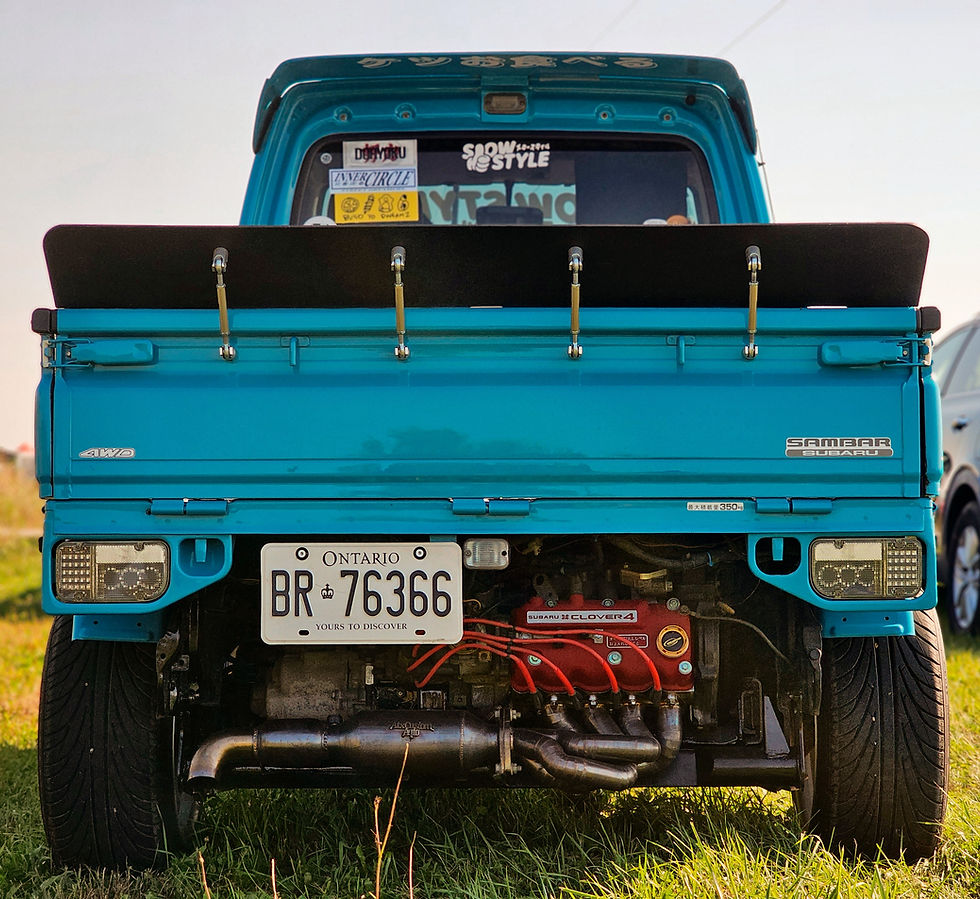
Now compare that to a kei truck — a 2008–2010 Suzuki Carry, Daihatsu Hijet, or Honda Acty, imported and road-ready for $7,500–$12,000 CAD. That’s right: for the price of one decked-out UTV, you could buy a kei truck and still have money left for a snowblower and a Costco membership.
Utility vs. Utility: Let’s Talk Actual Work
Both UTVs and kei trucks can carry a load — but in very different ways.
UTVs typically carry 450–680 kg (1,000–1,500 lb) in the bed, depending on the model
Kei trucks average 350–400 kg (770–880 lb) payloads, with 4WD and locking diffs available.
So payload wise, that's a slight win for the UTV.
UTVs also win slightly in off-road bounce factor and payload, but kei trucks hit back with roof, doors, mirrors, a heater and actual weatherproofing. That means no getting sandblasted in winter or inhaling every bug in Muskoka.
Plus, kei trucks can legally drive on paved roads — UTVs can’t, unless you fancy explaining your Polaris to a confused OPP officer.
Fuel & Maintenance: One Sips, One Gulps
Fuel economy is the kei truck’s secret weapon.
Kei trucks: 6–7 L/100 km (40 mpg)
UTVs: around 11–14 L/100 km (17–21 mpg) equivalent
UTVs require more frequent oil changes (every ~50 hours) and belt replacements, while kei trucks follow normal car intervals. Bonus: a kei truck can hit the gas station. A UTV needs a jerry can and leg work.
Repairs & Parts
Parts for UTVs are everywhere — but so are markups. A replacement drive belt for a Polaris Ranger can cost $200–$400 CAD, and tires average $250 each.
Kei trucks require importing parts from Japan (unless cross-referenced domestically), but the parts themselves are often cheaper — a full set of tires for under $400 CAD, and filters or brake pads for under $50 CAD each.
In short: UTV parts are at Canadian Tire. Kei parts are at “Add to Cart” on a Japanese site at 3 a.m. Both arrive in 3–10 business days… depending on your luck and customs.
Comfort, Safety & Street Legality
Kei trucks come with seatbelts, airbags (in newer ones), heaters, wipers, and functioning defrosters. They meet road safety standards.
UTVs? Not so much. You get a cage, a harness, and hope.
Most provinces classify UTVs as off-road vehicles only, meaning you can’t take them on public streets — no matter how good your argument about it “just being down the road to the mailbox”.
Meanwhile, kei trucks can zip into town, grab a Timmies, and head back to the field — all while your UTV sits parked, staring resentfully from the barn.
Off-Road Prowess: Dirt Royalty vs Mountain Goat
Let’s be honest — UTVs are built for punishment. Long-travel suspension, high clearance, and aggressive tires make them kings of rough terrain. Kei trucks can hold their own, but you’ll want a lift (2–4 inches, ~$500–$2,000 CAD) and knobby tires before pretending it’s a rally stage (https://www.minitruck.ca).
Still, kei trucks have one trick up their sleeve: they can haul equipment to the trail and then drive home — something a UTV can’t do without a trailer and a favor from your buddy with an F-150
Video proof?
Don't believe me? See the videos that made me a believer. Most are kei's in the 25 year old band of importing (a la the USA import laws), but the points are still the same.
Verdict: The Responsible Adult vs The Fun Uncle
UTVs are wild, loud, and unreasonably fun — like your uncle who bought a jet ski during a midlife crisis. Kei trucks, on the other hand, are the responsible adult in work boots: humble, efficient, and never complaining.
If your life involves fences, fields, and fun, the UTV will make you grin ear to ear. But if you want something that works year-round, runs on the road, and can haul a may bale one day and groceries the next, the kei truck quietly wins the long game.
So what is your opinion? UTV or Kei for your needs? Have both - we want to hear your insights! Comment below!


Comments