

Part 2 - Rims-shot: Why Are You Buying Wheels?
Updated: Jul 22
How to Choose Car Wheels: JDM Rims, Fitment, Style, and Performance
Last time we handled fitment, which is the sensible grown-up part of wheel shopping. It decides whether the wheel actually fits the car instead of just looking fantastic in a browser tab. This time, assume your fitment window is already sorted. The real question now is the one that actually decides what you should buy:

Why are you buying wheels?
Because there is no universal “best wheel.” The right wheel for a pothole-beaten daily, a Cars & Coffee showpiece, a grip build and a drift car is not the same thing. The non-negotiables are still the same boring-important fitment items — diameter, width, offset, centre bore, bolt pattern, brake clearance and load capacity — but once those are handled, wheel choice becomes a purpose decision. Also, yes, technically the rim is only part of the wheel. No, I am not asking you to correct everyone at Tim Hortons.
If your car is a daily driver or a daily with better style, the smart play is usually not “biggest wheel I can physically jam in there.” It is a reputable one-piece wheel with the right load rating, a finish that is easy to clean, and enough tire sidewall that the car does not feel like it is commuting on cast-iron dinner plates. That usually means cast or flow-formed makes more sense than going straight to expensive forged exotica. Canada’s freeze-thaw pothole special is real, and lower-profile tire/wheel packages are more vulnerable to pothole and curb damage.
Eye-candy

If the goal is show or pure visual impact, then yes, now we can talk about wheel jewellery. This is where mesh faces, deep lips, step rims and multi-piece wheels start making emotional sense. Work’s own breakdown of one-, two- and three-piece construction is basically the perfect explanation: modular wheels buy you design freedom and spec flexibility. That is why brands like Work and Weds’ luxury lines keep leaning into multi-piece mesh, luxury faces and bigger diameters. The catch is equally obvious: more money, more cleaning, and usually a little less indifference to curb rash.
Gorgeous? Absolutely.
Practical? Depends how often you parallel park.
Performance

If your answer is performance, track days or grip, stop shopping like a magpie and start shopping like a driver. Wheel mass matters. Unsprung mass affects ride and stability, and heavier plus-size setups can hurt stopping performance. This is why motorsport-bred wheels keep selling: lighter one-piece wheels, proper brake clearance, real testing and sane construction actually do something. That is the territory of wheels like the Enkei RPF1, WedsSport TC105X, ADVAN’s track-focused designs, BBS RI-A and the RAYS TE37 family.
Different styles, same basic mission: save weight, keep strength, clear brakes, go annoy apexes.
Drift
Even the best drift platforms kiss wall now and then... expect no less from your rims.
If the answer is drift, be honest with yourself. You do not need museum pieces on a car whose hobby includes angle, tire smoke and occasionally introducing the rear quarter to bad decisions. Drift-friendly wheel choices often lean toward simple spoke designs, tough construction and features like knurling that help reduce tire slip on the rim under hard driving.
The big beginner lesson here is not romantic: buy something strong that you can afford to replace. That is also why the best “street compromise” wheel for a lot of people ends up being a good flow-formed wheel — lighter and stronger than bargain-basement cast stuff, but nowhere near forged-money pain.
Specs and style
Here is the short version of the specs, minus the headache:

Diameter decides how much wheel you see and how much sidewall you lose.
Width and offset decide where the wheel sits relative to the suspension and fender.
Centre bore is the hub hole, and it matters because it helps centre the wheel properly.
Bolt pattern is the lug layout, but matching that alone does not mean the wheel fits.
Load rating is not optional trivia — the wheel has to be able to support the car properly.
If the last article taught you that width and offset control stance and rubbing, this article just adds the second half of the thought: those same numbers also control whether the thing is actually smart for the job you want the car to do.
Construction is where the money starts making sense.
Cast wheels are the normal entry point.
Flow-formed wheels harden and shape the barrel further, which is why brands like Enkei make such a big deal about MAT / MAT-DURA.
Forged wheels start with a billet and huge pressure, which is why companies like BBS and RAYS use them for their halo stuff.
Structurally, one-piece wheels are simple, strong, and practical. Two-piece and three-piece wheels are for custom widths, deep lips, face options, and people who say “spec” like it’s scripture. There is no moral winner — just what fits the build and what your wallet survives.
Style matters too. Mesh says VIP or old-school class. Split-spokes feel modern. Deep five-spokes bring track-car attitude. A retro Watanabe-style eight-spoke can make a classic Japanese car look like it already has stories.
And bigger is not automatically better. A larger wheel usually means less sidewall if you keep the tire diameter close to stock. That can sharpen response, but it can also make potholes feel like invoice generators. Sometimes more tire is the smarter move.
Price, and a note on 'cutting costs'
Two warnings before you pay. Used wheels can be a deal, but inspect barrels, lips, and mounting faces like paranoia owes you money. Bent or cracked wheels are not “probably fine.”
Fake wheels are worse. They may copy the look, not the material, testing, or quality control. Buy from real dealers, ask annoying questions, and treat miracle prices as suspicious.
Price matters, but purpose matters more. Enkei, Konig, gramLIGHTS, ADVAN, TE37s, BBS LMs — all live in different tax brackets for different reasons.
The point is not to buy the most expensive wheel. The point is to buy the wheel that suits the job.
Fitment tells you what can fit. Purpose tells you what makes sense. Ignore that, and you are just buying expensive circles for potholes.
A history section - for the wheel nerd in all of us.
RAYS / Volk Racing
RAYS traces its roots to Rays Engineering in 1973, with RAYS Co., Ltd. following in 1977 and a racing division launching in 1981. From there, the company leaned hard into forging technology, which is how it became one of the big names in Japanese performance wheels rather than just another company making shiny circles for people with tax refunds. That is the RAYS lane: forged monoblocks, motorsport credibility, track builds, drift builds, time-attack cars, and enthusiasts who can spot a TE37 from three parking lots away while pretending that is normal social behaviour.
Key lines / sub-brands
RAYS: parent company.
Volk Racing: forged racing / performance / halo line.
gramLIGHTS: sport-performance line; more accessible than Volk, popular for street, drift, and track-inspired builds.
HOMURA: premium cast street/show/luxury line.
VERSUS / VMF / A-LAP / RAYS Offroad: other RAYS lines covering style, premium forged, lightweight, and off-road applications.
Famous wheels
Volk Racing TE37 — the six-spoke legend; basically the JDM wheel equivalent of a sacred object with lug holes.
Work Wheels
Work Co., Ltd. was established in 1977. By 1979 it had opened a dedicated facility for producing three-piece wheels. In normal-person language, that means Work got very good, very early, at building wheels that could be customized for width, lip depth, offset, and face design instead of just stamped out in one fixed shape and sent into the world to do their best. That early focus on multi-piece construction is why Work became so closely tied to custom fitment, deep lips, show builds, drift cars, VIP sedans, and people who say “just 3 more millimetres” with the haunted confidence of someone who knows their fender clearance more accurately than their own inseam. Key lines / sub-brands
Work Emotion: sport / street / drift / motorsport-inspired line.
Meister: iconic multi-piece performance/show line.
Equip: retro/old-school line.
VS / Gnosis / Lanvec: luxury, VIP, show, and multi-piece styling.
Seeker: compact/street/custom-fitment style.
CRAG: SUV/off-road/rally-flavoured line.
Famous wheels
Work Emotion ZR10 — 10-spoke sports wheel for the Emotion line’s 20th anniversary, with Super GT-inspired technology and Work Flowforming Technology on some sizes.
Work Meister S1 3P — halo multi-piece classic; the wheel people picture when they say “Work Meisters.”
Work Meister M1 3P — premium multi-piece Meister option.
Enkei

Enkei is the practical legend of Japanese wheels: less “I sold a kidney for forged monoblocks,” more “I wanted something light, credible, and still have change to buy groceries.” Founded in Japan in 1950, Enkei became one of the most important names in mass-produced performance wheels, especially because of its focus on casting technology and its MAT process, which combines casting with rim-forming/spinning to improve strength and reduce weight without going full forged-wheel money. That makes Enkei the sensible enthusiast’s best friend: real motorsport flavour, broad availability, smart engineering, and just enough financial restraint to suggest the owner might still be allowed near the household budget.
Key lines / sub-brands
Racing Series: lightweight performance / motorsport-inspired wheels.
Racing Revolution: higher-performance modern racing line.
Tuning Series: street-performance and enthusiast applications.
Performance Series: broader daily/street use.
Classic Series: retro-flavoured designs.
Famous wheels
Enkei RPF1 — the default “smart lightweight wheel” reference; the wheel equivalent of ordering black coffee and meaning it.
Enkei RPF1RS — deeper-face / wider-style RPF1 evolution for people who liked the responsible choice but still wanted a little drama.
Weds / WedsSport

Weds is one of those brands beginners may not know immediately, but it has serious Japanese wheel history behind it. Weds traces back to Nippo Ltd. in 1965, entered the aftermarket wheel industry in the late 1960s, and developed major wheel lines through the 1970s and 1980s. The performance-facing name most relevant here is WedsSport, especially wheels like the TC105X, where Weds highlights obsessive weight reduction, machined side cuts, hub-wall material removal, and rigidity improvements. That gives Weds a nice split personality: serious lightweight performance wheels for people who care about lap times, and luxury/show lines for people who care about lip depth, face design, and making their sedan look suspiciously expensive.
Key lines / sub-brands
WedsSport: motorsport / lightweight performance line.
Kranze: high-end luxury, VIP, multi-piece styling.
Maverick: stylish street/show multi-piece line.
Leonis / F-Zero: broader street and premium styling lines.
Weds Adventure: SUV/off-road applications.
Famous wheels
WedsSport TC105X — lightweight performance wheel;
Weds Kranze / Maverick models — luxury, VIP, and multi-piece show culture.
SSR / Speed Star Racing

Originally Speed Star Racing (honestly, the most 'anime' sounding name on the list), SSR is old-school Japanese wheel culture with real engineering history behind it. SSR’s official site says the brand released the MK1 in 1971 as the first three-piece wheel, and connects the rise of aluminium wheels to the creation of JWL certification in 1973. SSR also states that its wheels are put through JWL testing before street or track use. That puts SSR right at the roots of Japanese aftermarket wheel culture: old-school street cars, early racing style, three-piece heritage, and people who use the phrase “period correct” with alarming sincerity.
Key lines / sub-brands
Speed Star: old-school heritage line.
Professor: multi-piece street/show/performance line.
Formula: classic mesh / motorsport-inspired heritage.
GTX: modern performance / accessible sport line.
Executor / Reiner: luxury/show multi-piece styling.
Famous wheels
SSR MK-I — key heritage wheel; SSR identifies it as the first three-piece wheel.
SSR Formula Mesh — iconic old-school mesh.
Yokohama / ADVAN Racing

ADVAN is Yokohama’s performance wheel brand, and it carries a slightly different kind of credibility because many enthusiasts know the ADVAN name from tires first. Yokohama’s current wheel catalogue lists models like the TC-4, RG-D2, RZII, GT, GT BEYOND, and GT BEYOND-R, including race-specific versions for 86/BRZ and Yaris Cup applications. That gives ADVAN Racing a clean performance identity: circuit cars, time-attack builds, modern grip setups, and owners who want the car to look like it might actually see an apex someday, even if its most common track is still the left-turn lane into Tim Hortons.
Key lines / sub-brands
Yokohama Wheel: parent wheel division.
ADVAN Racing: main performance wheel brand.
GT / GT BEYOND: forged five-spoke halo/performance line.
TC / RG / RZ lines: modern circuit, street-performance, and time-attack style.
Famous wheels
ADVAN Racing TC-4 — clean modern performance wheel.
ADVAN Racing RG-D2 — step-rim / concave performance look.
ADVAN Racing RZII — twin-spoke modern performance option.
ADVAN Racing GT — forged five-spoke performance wheel.
ADVAN Racing GT BEYOND / GT BEYOND-R — premium modern halo option.

RS Watanabe

RS Watanabe is retro JDM royalty. The brand’s own site says the Eight Spoke — its 8-spoke kamaboko-shaped wheel — is its signature product and that it established the image of “8 spokes = RS Watanabe” in the aluminium wheel industry. Auto Messe Web describes RS Watanabe as a traditional Japanese wheel brand and identifies the Eight Spoke as a perennial favourite that debuted in 1968, connecting it to classic Japanese cars and the AE86 from Initial D. That makes Watanabe less of a trend and more of a visual shorthand: old Zs, AE86s, classic Skylines, Sunny Trucks, and cars that look like they have stories before the engine even starts.
Key lines / sub-brands
Eight Spoke: the core identity of the brand.
F Type / F8: classic smaller-car fitments.
R Type: more aggressive classic fitments.
RM8 / magnesium references: higher-end heritage/racing discussion where relevant.
Famous wheels
RS Watanabe Eight Spoke — the essential wheel; the brand’s signature product. Culturally tied to cars like the AE86, S30 Z, classic Skyline, RX-3, Civic, and Sunny Truck.
RM8 / magnesium references — halo heritage/racing note.
Eight Spoke on classic JDM builds —
BBS Japan
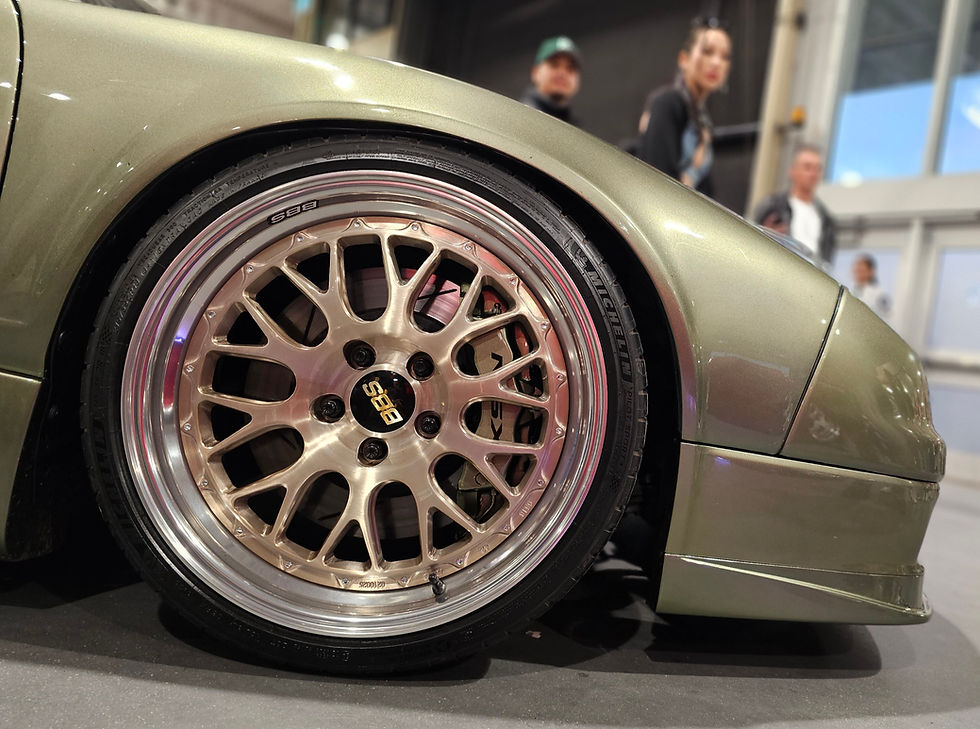
BBS is originally German, but BBS Japan belongs in this conversation because Japanese forged-wheel manufacturing and Japanese-market BBS culture are a major part of the brand’s modern identity. BBS Japan’s official product list is full of forged models, including forged aluminium one-piece wheels like the FI-R and RI-A, forged aluminium two-piece wheels like the LM and SUPER-RS, and forged extra-super duralumin models like the RI-D and RZ-D. That puts BBS Japan in the calm-expensive corner of wheel culture: forged mesh, motorsport prestige, OEM-plus luxury, and the kind of wheel that does not need to shout because the invoice already did.
Key lines / sub-brands
BBS Japan: Japanese forged-wheel manufacturer tied to the broader BBS name.
Forged one-piece wheels: RI-A, FI-R, RE-V7, RF, RP.
Forged two-piece wheels: LM, LM-R, Super-RS, RI-S, RS-GT.
Extra-super duralumin models: RI-D / RZ-D halo engineering.
Famous wheels
BBS LM — forged two-piece classic; Le Mans-linked prestige.
BBS Super-RS — forged two-piece mesh royalty.
BBS RI-A — forged one-piece motorsport/street-performance option.
BBS FI-R — forged one-piece halo/performance wheel.
BBS RG-R / RF / RP — forged one-piece options useful for broader fitments.
Then of course, the choice is yours!
And after all of that, here is the part where I ruin the purity test: you do not have to put Japanese wheels on a Japanese car.
Quacktastic is by far one of the funnest build I've seen!
Yes, this is theJDMDream.ca, so obviously I am going to talk about RAYS, Work, Enkei, Weds, SSR, ADVAN, Watanabe, BBS Japan, and all the other wonderful ways Japan has helped enthusiasts financially inconvenience themselves. These brands matter. They have history, engineering, motorsport credibility, and cultural weight. But your car is still your car. The wheel choice should suit the build, the roads you drive on, the budget you live with, and the look you actually want when you walk away from the car and turn back for that little second glance we all pretend we do not do.
There are plenty of excellent wheel companies outside Japan making strong, well-designed, great-looking wheels. The goal is not to pass some imaginary JDM citizenship test at the border of Cars & Coffee. The goal is to choose wheels that fit properly, suit the car, and express what you are trying to build. That is also why the JDM Dream is proud to be partnering with Klutch Wheels for our upcoming show car next year.

They are coming on as a sponsor, and we appreciate that support — not because every build needs the same wheel, but because every build needs the right wheel for its own personality. Some cars need the wheel equivalent of Air Jordans. Some need racing shoes. Some need polished penny loafers because the owner has gone full VIP sedan, cambered confidence, and possibly owns a smoking jacket.
In the end, wheels are where engineering meets personal taste. Fitment tells you what can physically work. Purpose tells you what makes sense. Style tells people who you are — or at least who you are pretending to be until the next paycheque.
So what's your build dream? Post picks of your ride and your dream wheels below!


Comments